Binder checklist for emergencies: what to copy and what to write down
Published 2026-10-18 · Updated 2026-10-18

An emergency binder checklist follows four record groups in the Emergency Financial First Aid Kit: household identification, financial and legal documentation, medical information, and household contacts.
For each group, copy the paper or write the detail. Copy means a photocopy or a saved file of a document you already have. Write means a line in the binder: a name, a phone, a location, or the last four digits. The kit's account form asks for the last four digits of the account number, not the full number.
The fema.gov copy of this kit returned a refusal when we fetched it. The checklist below uses the Ready.gov copy of the same kit, which Ready.gov describes as a joint publication from Operation HOPE and FEMA.
Four groups from the kit
Ready.gov's kit page says the kit helps you organize critical financial, medical, and household information, and that it includes a checklist of important documents and forms. The opened PDF sorts that checklist into the four groups above. Use them in that order. Skip a line that does not apply to your household.
Household identification. Who lives here, and the papers that prove it.
Financial and legal documentation. Housing, insurance, income, tax, and the location of any will or power of attorney.
Medical information. Who the clinicians are, and copies of insurance cards. This checklist does not give health advice.
Household contacts. The people and desks you would call: landlord or mortgage representative, insurer, lawyer, bank, advisor.
Copy these papers
Copy, if you have them, and store the copy with the binder or in the same cloud folder:
- Photo ID, front and back. The kit says to photocopy the front and back of a driver's license or other photo ID.
- Birth certificate, marriage record, and passport identity pages, or a note that a certified copy comes from the issuing office. USAGov says to contact the vital records office of the state or territory of birth for a certified birth certificate, and the State Department for a passport replacement.
- Lease or mortgage papers, and the insurance declarations page.
- One recent pay stub, and a filed tax return. IRS recordkeeping guidance says keep records for 3 years when the longer cases on that page are not yours. The binder needs the return's location more than a stack of receipts.
- Health insurance card, front and back.
The kit's medical checklist includes physician contacts, a copy of the health insurance card, and a list of medications. If you copy a prescription, copy the label as printed. Add no dose and no schedule of your own.
Wills, trusts, and powers of attorney are prepared with an attorney. The kit PDF calls a power of attorney a legal document that a lawyer should write and review. Copy the signed document only if you already have a spare copy. Otherwise write the location. Do not draft a new one on a checklist line.
Write these details
Write these lines even when you also store a copy:
- Household names, address, and a work contact for each job.
- Pet name, ID tag, and microchip number if there is one. A photo of you with the pet is what the kit suggests as proof of ownership.
- Institution name, account type, phone, website, and last four digits.
- Insurer name, claims phone, and where the policy packet is.
- Attorney name, and where any signed will or power of attorney is kept.
- Contacts from the kit's household-contacts list: landlord or mortgage representative, insurance agent, lawyer, banking institution, financial advisor, and a house of worship or civic contact if you use one.
Sharing a bank account number, a Social Security number, or a credit card number is what Ready.gov's financial preparedness page says to be cautious about. Those full numbers stay off the written page. The kit recommends keeping written password lists away from the paper copy. A hint, if you use one, lives in a different place.
Ready.gov says to store important documents in a safe deposit box, on an external drive, or on the cloud. Write which of those you chose, and who else can open it. A copy nobody can find is the same as no copy.
A supply kit is a different list
Ready.gov's supply-kit page describes a collection of food, water, and other supplies to last for several days. That list is for a go-bag or a closet bin. It is not this document checklist. Keep the supply list with the supplies. Keep the document checklist with the papers.
The Anderson Advisors page describes two sections and a separate password sheet. The Anderson Advisors page describes a password sheet and has no Household Identification heading.
The Merrill Project step-1 page is about gathering a binder, sheet protectors, and a copy pile. The Merrill Project step-1 page has no insurance checklist.
A Pinterest pin is the second listing. That pin stayed behind a bot wall, so it is unread in this guide.
A form that matches the write-versus-copy split
You can print this checklist and tick the lines by hand. A form is useful when you want the "location" and "last four digits" fields already drawn, so a full number has no printed box.
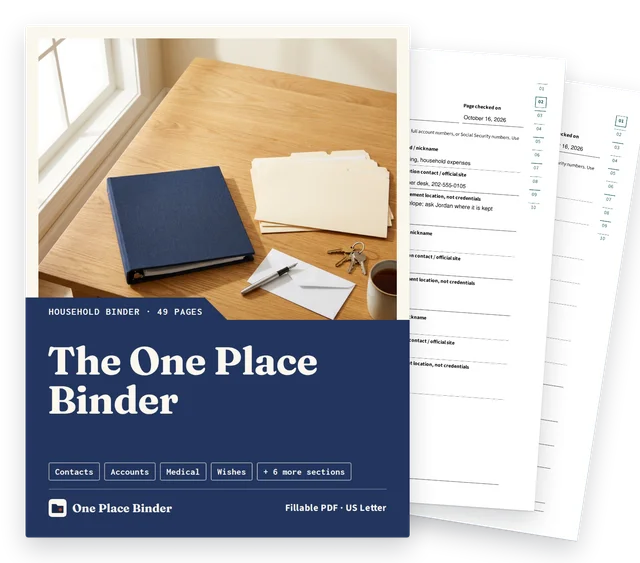
The One Place Binder keeps one household's contacts, accounts, insurance, property and car, pets, digital life, document locations and wishes in one place, and tells a trusted person where it is. It is one fillable PDF, US Letter, priced at $11.99. Document-location pages record where papers are kept. Not legal advice. Not a will.
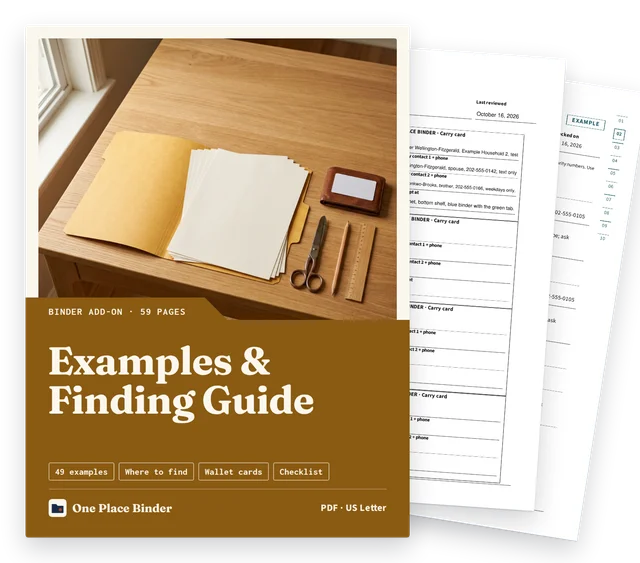
The Examples and Finding Guide is a gather-it-first checklist with 20 tick boxes, plus a where-to-find guide for 27 document types, for $4.99. It holds no blank binder sections, so the binder is a separate file.
A checklist does not create a certified copy, and it does not sign a will. That is the limit. The issuing office still makes the certified copy. An attorney still prepares the legal papers. The checklist tells you which copies to make and which lines to write.
Where to keep the finished file is covered in how to store important documents. The paper types are in the important documents list. A folder meant for a family to open later is the death binder guide.