Important documents a household should track
Published 2026-10-16 · Updated 2026-10-16
Track these household papers, in four groups. The groups come from FEMA's safeguard sheet. For each paper, write who can issue another copy, and where the copy you already hold is kept. A list with no locations is a reminder, not a file.
Household identification
- Birth certificate. A certified copy comes from your birth state or territory's vital records office, as USAGov explains. Keep the paper you have with other hard-to-replace originals.
- Marriage record, divorce record, and death certificate, if they apply to your household. USAGov links those record types next to the birth-certificate instructions. Keep the certified copies you already have.
- Adoption or child-custody papers, if you have them. FEMA lists them with vital records. The court or agency that issued them is who to ask for another copy.
- Driver's license or state ID. USAGov says to contact your state motor vehicle agency for a replacement. Carry the current card; note on your index where a spare photocopy sits, if you made one.
- Social Security card. USAGov points to the Social Security Administration to replace a card online, by mail, or in person. The SSA publication on identity theft says to keep the card, and any other document that shows your number, in a safe place, and not to carry the card routinely.
- U.S. passport, if you have one. USAGov says to report a lost or stolen passport to the State Department, then request a replacement in person. Keep the passport with other identity papers, not loose in a bag you do not watch.
- Permanent resident card or naturalization certificate, if you have one. USAGov names U.S. Citizenship and Immigration Services for a replacement card, and Form N-565 for a replacement naturalization certificate. Confirm the current form on that USAGov page before you send anything.
- Military service identification, if you have it. FEMA lists it with other identity papers. The office that issued it is who to ask for a replacement.
- Pet ownership papers and identification tags. FEMA lists them so a pet can be matched to the household. Keep tags on the animal and a paper copy with the other identity papers.
Housing, vehicles, and money papers
- Lease or rental agreement, mortgage, home-equity papers, and the deed. FEMA groups these as housing documents. The office or lender that issued each one is who to ask for another copy. Do not guess a county counter from memory and call it a rule.
- Vehicle title, registration, loan papers, and the VIN. FEMA lists them together. A replacement driver's license is a motor-vehicle-agency task on the USAGov page; ask that same kind of agency about a title only if it issued the title. Write the agency name on your index once you know it.
- Insurance policies: homeowners or renters, auto, life, and flood, plus appraisals or a photo list of valuable items if you have them. FEMA lists those so you can reopen a claim. The declarations page is the paper to index. The insurer named on that page is who to ask for a duplicate.
- Checking, savings, retirement, and investment records you still need, including debit-card paperwork. FEMA lists financial accounts as their own line. Keep the latest statement that shows the account exists, and shred older statements once they support nothing you still need.
- Pay stubs or other income records, and letters about government benefits, while you still need them to show income. FEMA lists sources of income next to tax statements.
- Federal and state tax returns, property-tax bills, and vehicle-tax bills. The IRS how-long page says to keep copies of filed returns, and to keep property records until the period of limitations expires for the year you dispose of the property. How long the supporting bills stay is a separate question from whether they belong on this list.
- Utility bills, credit-card statements, student-loan papers, and other obligations FEMA lists under financial documents. Keep the current ones that show what you owe. Older ones stay only while they support a tax item or a dispute.
Contacts and health-plan cards
- Names and phone numbers for the bank, the insurer, the employer, the school, a house of worship, and home-repair services. FEMA lists household contacts on the same sheet as the papers.
- Health-plan cards, including Medicare or Medicaid cards if you have them. USAGov says a Medicare card can be printed from a Medicare account or requested by mail, and a Medicaid card comes from the state Medicaid office. Store the card with your identity papers. This page does not tell you which plan to choose or how to use a benefit.
- A caregiver agency contract, if you have one. FEMA lists that contract with other papers to safeguard. The agency named on the contract is who to ask for another copy.
Wills and other legal papers
A will, a trust, or a power of attorney is prepared with an attorney, or through the official process that document uses. This page does not tell you which ones to sign, and it does not say any of them is required. FEMA's safeguard sheet lists a will, a trust, and a power of attorney among papers to safeguard once you have them. Record where the signed original is. Ask the attorney who prepared it, or the office that accepted it, where that original should stay.
Where the copy you hold should sit
FEMA says to consider storing paper copies at home in a fireproof and waterproof box or safe, in a bank safe deposit box, or with a trusted friend or relative. If you use a bank box, ask the bank, or check state law, about who can open it. Ready.gov also names a safety deposit box, an external drive, or the cloud as places to store important documents. Write the choice on the index. "Somewhere safe" is not a location.
Ingleside's legal-document checklist has no index of where each paper is kept. Ingleside is stronger on how a will and a power of attorney work. David York Agency's article links an Essential Documents worksheet with columns headed Have Original, Have Copy, and Location of Documents. That location table is where the worksheet is stronger. Both are care-provider articles. This list is not a care plan.
Record the locations
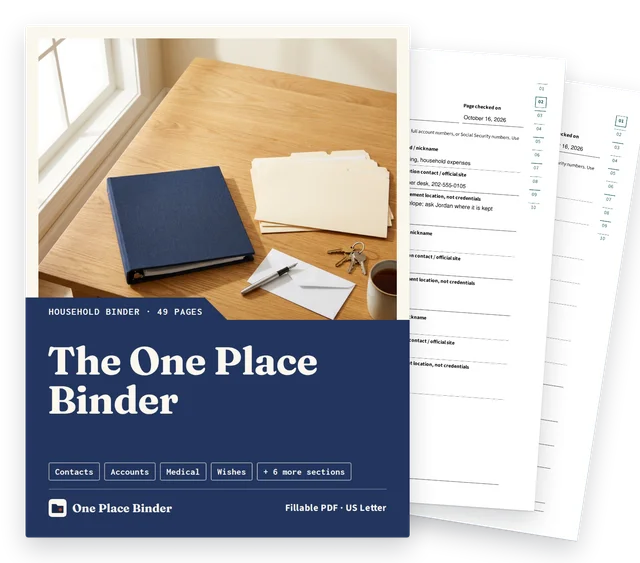
The One Place Binder has an important-documents section and document-location pages, so each original has a line for where it is kept. The One Place Binder is a fillable PDF on US Letter paper. The One Place Binder is $11.99. Wishes pages record preferences and where real documents are kept; they do not replace a will or other legal document. Not legal advice. Not a will.
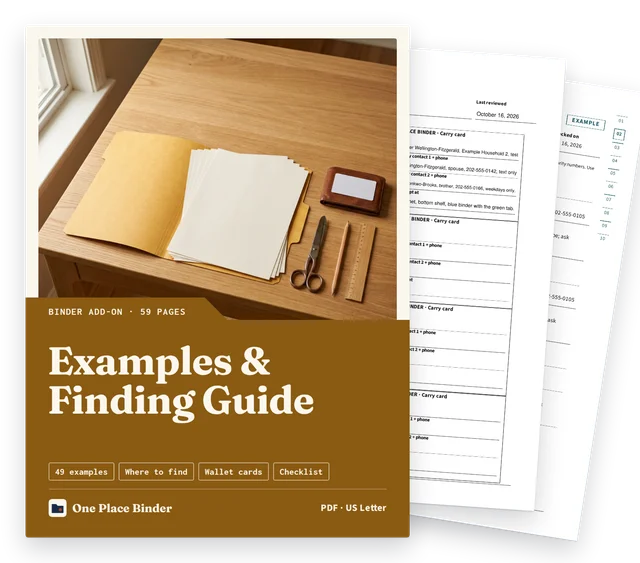
The One Place Binder: Examples & Finding Guide has a where-to-find guide for 27 document types, with a suggested place to look and who to ask for a copy in the US. The One Place Binder: Examples & Finding Guide is one PDF on US Letter paper. The One Place Binder: Examples & Finding Guide is $4.99. The One Place Binder: Examples & Finding Guide holds no blank binder sections, and the One Place Binder is sold separately. The guide lists places to look as suggestions, not as facts about where your original already is.
A list does not create the papers. If you do not have a deed, a passport, or a will, this page does not tell you to go get one today. It tells you to track the ones you have, and to use the issuing office named above when you need a replacement. How to sort them is on how to organize important documents. A household binder that holds more than this list is the home binder guide.
Questions
What are some important documents I should keep forever?
Keep a birth certificate, passport, and Social Security card for as long as you use them to prove identity. Keep property records until the IRS limitation period ends for the year you dispose of the property. Neither rule is a shred date for every folder.
What are examples of important documents?
Examples are a birth certificate, a driver's license, a Social Security card, a passport, a deed or lease, a vehicle title, insurance policies, and copies of filed tax returns. FEMA's safeguard sheet groups them that way.
What are the most important documents to keep forever?
Identity papers you still use, plus property records you need to figure gain or loss later. A will is made with an attorney; keep the signed original where that process told you to keep it.
What are the most important documents?
Start with papers that prove who you are, what you own, what you owe, and what your insurance covers. Add contact names for the bank, the insurer, and the employer.
What are some important documents?
Birth and marriage records, a passport, a Social Security card, housing papers, a vehicle title, insurance policies, and tax returns are the core set on FEMA's safeguard sheet.
What are some important documents I should have?
Have the identity papers you use, the housing and vehicle papers for what you own, current insurance, and a copy of each filed tax return. Record where each original sits.
What are the most important documents to have?
The ones you cannot replace from memory: vital records, a Social Security card, a passport, a deed or lease, and a vehicle title. Insurance and tax copies come next.
What are some examples of important documents?
A certified birth certificate, a marriage record, a driver's license, a lease, a home insurance policy, and last year's tax return are everyday examples. Your list will be shorter or longer than a neighbor's.
What documents should I keep forever?
Do not shred identity papers you still use, and do not shred property records before the IRS period for the year you sell or give away the property has ended. Ask an attorney where a signed will should stay.
Sources
- Safeguard Critical Documents and Valuables
- How to replace lost or stolen ID cards
- Identity Theft and Your Social Security Number
- How long should I keep records?
- Financial Preparedness
- Important Legal Documents: A Checklist
- important information and essential documents checklist
- Essential Documents & Emergency Information Worksheets