Checklist for the first days in a new house
Published 2026-10-16 · Updated 2026-10-16

In the first days, confirm the house works, then start a record. Check water, power, and heat, and write the start dates. Install or confirm smoke alarms on every level. Plan a radon test. File the postal change and tell the IRS. Write who still has the old address, and where the closing papers or the lease are kept.
Allow at least 7-10 business days after an approved change-of-address request before it takes effect, the U.S. Postal Service says. If the request is still open, file it promptly, and allow the stated approval time before the new address takes effect.
First days in the house
Day you arrive
- Walk once before the rooms fill with boxes. Note keys, garage openers, and anything you want the seller or landlord to see while it is still visible.
- Confirm water, power, and heat respond. Write each provider, the start date, and whether start was confirmed.
- Find the smoke alarms. Ready.gov says to install smoke alarms on every level of your home, including the basement, and to replace batteries twice a year, unless you are using 10-year lithium batteries.
- Put closing papers or the lease, plus the utility notes, in one folder. Write on the folder where it lives.
Same week
- Order or place a radon test. The EPA radon page says testing is the only way to know your level of exposure, and that all homes should be tested for radon.
- File the postal change if it is still open. USAGov points to USPS.com/move and says a separate company is unnecessary for that change.
- Tell the IRS. IRS Topic 157 says you need to notify the IRS so you receive refunds and correspondence, and it names Form 8822.
- List who still has the old address: bank, insurer, employer, subscriptions, and the offices that send you mail. Write the date you told each one.
- Set a small supplies kit aside. Ready.gov's kit page says a basic kit could include water at one gallon per person per day for several days, for drinking and sanitation, plus a several-day supply of non-perishable food.
The wider move, including quotes and the week before, is the checklist for moving. Address updates in more detail are the change of address checklist. Recurring house jobs after this week belong on the checklist for home maintenance.
Alarms, radon, and a small kit
Smoke alarms are a first-week check, not a project for later. The Ready.gov home-fires page, linked above, is the source for every level and for replacing batteries twice a year. Follow the alarm maker's instructions for placement. This page does not add a placement rule of its own.
Radon testing is the same kind of check. The EPA page says testing is the only way to know the level, and that all homes should be tested. Pick a test, write the date you placed it, and write where the result will be kept. The result is a number you record. This article does not interpret it.
The kit is a few days of water and food, stored where you can reach it. Ready.gov describes that kit for the period after an emergency. Set water and food aside, and use that page if you want the longer item list.
Mail, tax, and the new address
With a permanent change in place, USPS says standard mail forwarding lasts 12 months, while First-Class Mail is forwarded for free. Forwarding leaves the bank, the insurer, and the IRS on the old address until you tell them.
Online, that USPS page says to pay the $1.25 identity verification fee. If the online check fails, the same page says to finish at a post office with photo identification.
Form 8822 is the individual IRS address form named on Topic 157. Keep a copy with the closing papers. A postal change is a separate form.
Starting the house file
Day one is the right time to start the house's records, while the dates are still fresh. One page is enough:
- Move-in date, old address, new address
- Utility provider, stop date at the old place if you had one, start date here, confirmed or still open
- Who you told, the date, and whether they still have the old address
- Where the closing papers, the lease, the alarm notes, and the radon test result are kept
The second result, Moving.com, covers utilities, mail, locks, and cleaning before you unload. It has no date-notified line. The first result, a Reddit thread, was blocked and was not read. Realtor.com, the third result, is mostly a before-move list. Zillow's homeowner checklist, which we opened as the next readable page, is a longer owner list. None of those pages is a file you fill in on day one.
A planner for the dates you just wrote
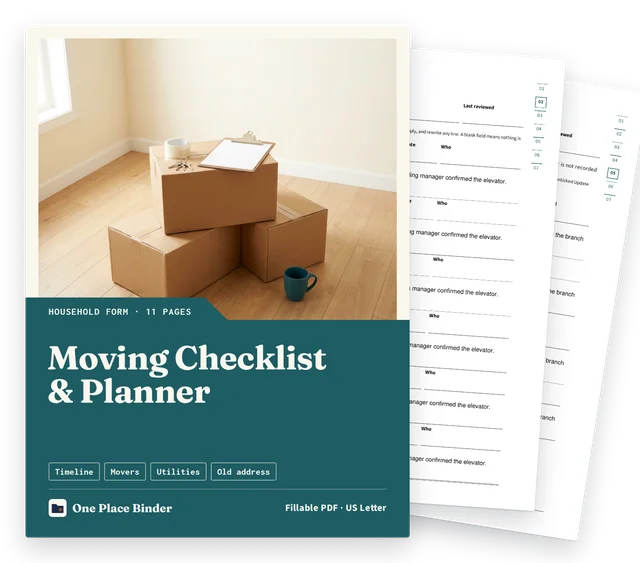
For day-one records, the Moving Checklist & Planner is one fillable PDF, US Letter. The Moving Checklist & Planner lets you plan a household move in one file: work through a timeline, compare mover quotes, log when utilities stop and start, and track who still has your old address on day one. That old-address tracker covers the notification part of the day-one list above, with a date-notified field on each record. Get the Moving Checklist & Planner for $3.00 to start the house file. For the house file, the Moving Checklist & Planner has typing tested only with pdf.js (Firefox's PDF engine); other apps not tested. Not legal advice. Not a will.
This planner prints no deadlines, lead times or official requirements. You choose your own dates and check each mover and provider directly in the first week. It is not a radon report and it is not an alarm manual.
What to confirm with each provider
This list can tell you which calls to make in the first days. It cannot tell you the start date your utility will actually give you, or what your alarm maker prints on the unit. Call them, write what they say, and keep that note with the papers. That is the limit of a general first-week list, and it is still useful if you buy nothing.
Questions
What are the first things to check in a new house?
Check that water, power, and heat respond, that smoke alarms are in place on every level, and that you have a note of the utility start dates. Then file the postal change if it is still open.
What to do immediately after moving into a new house?
Set up beds, confirm the utilities you scheduled, test that smoke alarms are present on every level, and write where the lease or closing papers are kept.
What is the first thing you do when you move into a new house?
Confirm the utilities respond and write the start dates. Mail and alarms come the same day, after you know the lights and water work.
What are the first things I should do when I move into a new house?
Utilities, smoke alarms, a radon test plan, the postal change, and a one-page note of who has been told the new address.
What to check when you move into a new house?
Check utilities, alarms, keys, and the papers from closing or the lease. Write the date and where those papers will live.
What should I do after moving into a new house?
Finish the address updates, tell the IRS, and start a simple house file: utility dates, alarm notes, and who still has the old address.
What is the first thing you should do when you move into a new house?
Make sure water and power are on, and write the dates the providers gave you. Everything else in the first week hangs on that.
What to do first when moving into a new house?
Walk the house once, confirm utilities, and put closing papers or the lease where you can find them again tomorrow.
What are the first things you should do when moving into a new house?
The same short set: utilities, alarms, mail, the IRS notice, and a record of where the papers are.