Address change checklist: who to notify when you move
Published 2026-10-16 · Updated 2026-10-16
Tell the post office, then tell every sender yourself. A USPS change-of-address order only changes your mailing address with the Post Office. The same page says you are responsible for telling government agencies, companies, and any other senders that your address has changed.
Group the list, and write three facts for each name: the date you notified them, whether they still have the old address, and whether the update is confirmed. The first result checklist has no date-notified field. The second result checklist has no update-confirmed box.
Who to notify, by group
Work the groups in this order. The names inside each group come from the opened checklists and from USAGov's address page. A name is on the list because that sender mails you, not because one national statute names every company.
Postal service. File a permanent change of address if you are moving. USPS says a temporary request is for a relocation of 15 days up to 1 year. Standard mail forwarding lasts 12 months. You can pay to extend forwarding. Read the month counts and the price on the USPS page when you file, rather than copying them from a blog.
Government records. USAGov lists federal taxes, Social Security, veterans benefits, immigration, driver license and vehicle registration, and voter registration. Use Form 8822 to notify the Internal Revenue Service of a change to your home mailing address. USAGov's voter page says to visit vote.gov to register or to update a registration, and it names voter registration deadlines as a state-by-state item, not one national day.
License and plates. Rules differ by state. Shea Homes says address-update processes and timelines may differ from state to state, and that not every state issues a new license card. One example, not a national rule: the California DMV new-resident page says that if you intend to become a California resident and drive in California, you must apply for a California driver license, and that a vehicle brought from another state must be registered within 20 days of becoming a resident or bringing it into the state. If you are not moving to California, use your destination state's own page.
Money and insurance. Banks, credit cards, lenders, brokerage accounts, and insurers. Tell each one. USPS lists credit cards, bank statements, and insurance info among sensitive documents that mailers keep out of forwarding.
Utilities and services. Electric, gas, water, trash, internet, phone, and streaming or other subscriptions that still use a mailing address. Schedule stop and start with each provider. That log is a separate job from this notify list.
Health-office contacts. Clinics, dentists, pharmacies, and a vet if a microchip or a bill uses your address. Copy the address they ask for. This is a mailing update, not medical advice.
Memberships and people. Schools, employers, clubs, places of worship, and friends or relatives who ship gifts. An email with the new address is enough for people. Companies usually want the change inside the account.
What forwarding actually does
File on the official USPS page, not through a third-party "we will file it for you" site. USAGov says scammers may charge $40 or more for a filing that page prices at $1.10 on the official site. The USPS page says to pay a $1.25 identity verification fee, and that the billing address on the card must match either the old or the new address. Those two official pages do not print the same fee. Use the figure on the USPS page on the day you file.
After the request is approved, allow at least 7-10 business days for it to go into effect. About 5 business days before the start date, USPS says you will get a Customer Notification Letter, with a confirmation code, at the new address. A Move Validation letter goes to the old address. Keep both with your move papers.
First-Class Mail, Priority Mail, and USPS Ground Advantage items are forwarded for free. Periodicals are forwarded for free for 60 days if fully prepaid by the sender. Media Mail is forwarded, and you pay the cost of shipping from the local post office to the new address.
Sensitive mail is the reason the rest of this list exists. USPS names identity documents, especially driver licenses and voter registration, plus credit cards, bank statements, insurance info, and other financial or medical information, as pieces mailers keep out of forwarding. Contact the sender.
A tracker, not another bullet list
The opened pages are lists. Shea Homes walks through USPS, the DMV, the IRS, Social Security, voter registration, banks, utilities, insurance, clinics, and people. Apache Moving's page is a short Texas-oriented list: post office, Texas license and registration links, voter registration, school, and utilities. Neither page gives you a row you can tick after the call.
For each name, write:
- Who. The company or office, and a phone or web page.
- Date notified.
- Still has the old address. Leave this ticked until they confirm.
- Update confirmed.
- Follow-up. Two lines: what they asked you to send, or the date you will call again.
An illustrative row, not your bank: "credit union, told March 2, still has old address, not confirmed, follow-up: they asked for a statement photo." The date is made up.
When the "still has the old address" column is empty, the list is done. Until then it is a working list, not a souvenir.
The whole-move timeline sits in the checklist for moving. State license, registration, and voter steps, kept apart from ordinary moving tasks, are in the moving out of state checklist.
A file for the notify rows
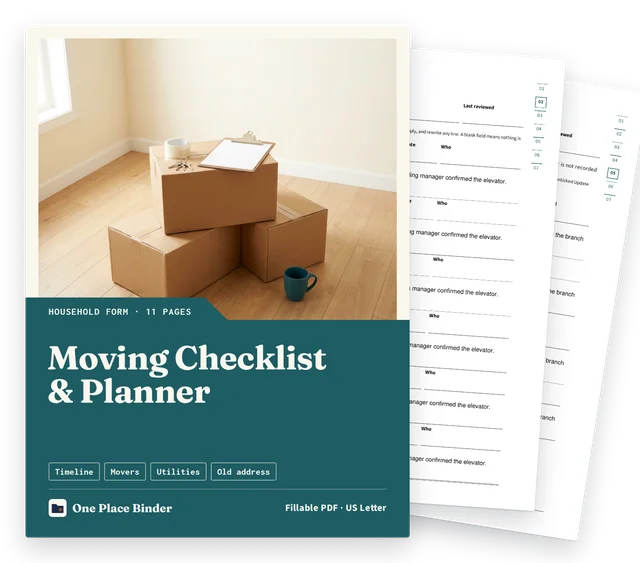
The Moving Checklist & Planner is one fillable PDF, US Letter, for address updates. The Moving Checklist & Planner includes a Who still has my old address tracker: 12 records in six groups (utilities / services, finance / insurance, government records, health contacts, memberships / subscriptions, people / other), each with a date notified, still-has-old-address and update-confirmed boxes and a two-line follow-up field. It contains no postal-service forwarding steps, fees or rules; ask each organization how it updates your address. The Moving Checklist & Planner costs $3.00. Not legal advice. Not a will.
You can keep the same columns in a notebook. Forwarding still ends, and senders still need a direct update, whether or not you buy the file.
Questions
What is everything you need to change your address on when you move?
USPS, then the senders USPS will not cover for you: government agencies, banks and card issuers, insurers, utilities, employers, schools, clinics, memberships, and people who mail you. The USPS page says a change of address order only changes your address with the Post Office.
What are things I need to change my address on when I move?
Start with the post office, the IRS home-mailing-address form, voter registration, and your state's license and registration office. Then add every company that sends you mail or a bill.
How far in advance should you change your address when moving?
USPS says that once a change-of-address request is approved, allow at least 7-10 business days for it to go into effect. File when you know the new address, not the morning the truck leaves.
When should I change my bank address when moving?
As soon as the new address is real. USPS lists bank statements and credit cards among sensitive mail that financial institutions keep out of forwarding. Tell the bank directly.
Do I need to change my address on everything when I move?
Yes for anyone who sends you mail you still want. Forwarding is temporary and skips some sensitive pieces. A short list with a confirmed box shows what is still open.
Where do I need to change my address?
At the post office, with each government office USAGov names, and with each company on your own list. One USPS filing does not update the others.
What is everything I need to change my address on when I move?
Postal forwarding, federal taxes, Social Security if you receive it, voter registration, license and plates in the new state if that state requires it, plus banks, insurers, utilities, work, school, and subscriptions.
Who all needs to be notified when you move?
The post office, government record-keepers, money and insurance companies, utility and service accounts, health-office mailing contacts, memberships, and people who send you packages.
Do I have to tell my bank I moved?
Tell the bank if you want statements and cards at the new address. USPS says financial institutions keep bank statements and credit cards out of forwarding, and that you are responsible for telling companies yourself.