Home maintenance checklist, by season, with cited intervals
Published 2026-10-16 · Updated 2026-10-16

A useful home maintenance checklist is a short set of tasks with an interval you can name, plus a place to write what you actually did. The intervals below come from agency pages. Where two pages disagree, both are named, and the appliance manual wins.
Monthly checks with a published interval
Test each smoke alarm monthly, which is the care step the U.S. Fire Administration gives for a battery model, a long-life lithium model, and a hardwired alarm.
Check the heating and cooling filter every month, especially in winter and summer, and change it if it looks dirty after a month; at a minimum, change the filter every 3 months, which is the ENERGY STAR filter guidance. The Environmental Protection Agency says to replace filters according to the manufacturer's recommendations, and that manufacturers typically recommend replacement every 60 to 90 days. Those two pages are close, not identical. Check the filter label or the furnace manual and write that interval down.
Some fire extinguishers need to be shaken monthly, and others need a pressure test every few years, which the U.S. Fire Administration's extinguisher page assigns to the label rather than to a general calendar.
If you use a woodstove, inspect and clean the pipes and chimney annually and check monthly for damage or obstructions, which is the pair of steps on Ready.gov's home fires page.
Clean the dryer lint screen before or after each load, and clean the dryer vent and exhaust duct periodically, checking that air leaves the outside vent while the dryer runs, which is the Consumer Product Safety Commission dryer publication. The duct timing on that publication is "periodically," so use the dryer manual for a month count.
Yearly work, where two pages disagree
Plan a heating and cooling tune-up once a year, which ENERGY STAR describes as a yearly tune-up, and have equipment more than 10 years old, or equipment that is not keeping the house comfortable, evaluated by a professional contractor.
Replace the entire smoke alarm every 10 years from the manufacture date, which the U.S. Fire Administration states for a battery alarm and for a hardwired alarm. Ready.gov says to replace the unit every 10 years or according to the manufacturer's instructions.
Battery timing is the disagreement. The U.S. Fire Administration says to replace the batteries at least once every year on a battery alarm, and to replace the backup battery at least once every year on a hardwired alarm. Ready.gov says to replace batteries twice a year, unless you are using 10-year lithium batteries. Both pages also point you to the manufacturer's instructions. Follow the sheet that came with the alarm you have.
Install carbon monoxide alarms with a battery or a battery backup on every level of the home and outside sleeping areas, and check the batteries regularly, which is the install step from the Consumer Product Safety Commission. Ready.gov's winter page says to install and test smoke alarms and carbon monoxide detectors with battery backups as part of preparing the home. Neither page sets a single national test month for the carbon monoxide alarm, so use the alarm instructions.
One pass for each season
Season names are a way to group work. They are not a due date by themselves.
In spring, clear debris from gutters, downspouts and drains, which is the declutter step on Ready.gov's flood page. That page leaves the month to you. Spring is a practical time if winter left debris, and fall is a practical time if leaves are the problem. A yearly heating and cooling tune-up fits spring if that is when you start using cooling, which is a scheduling choice, not a separate interval from the ENERGY STAR yearly tune-up.
In summer, keep the filter check because ENERGY STAR names summer as a heavy-use month. The dryer lint screen stays a each-load task in hot weather, from the Consumer Product Safety Commission.
In fall, prepare the home to keep out the cold with insulation, caulking and weather stripping, and install and test smoke alarms and carbon monoxide detectors with battery backups, which is the cold-weather prep on Ready.gov's winter page. Clear gutters again if leaves are falling, under the same Ready.gov flood note to declutter drains and gutters. A wood-burning chimney gets its annual cleaning on the Ready.gov home fires page before you use it.
In winter, keep the monthly smoke-alarm test from the U.S. Fire Administration and the filter check, because ENERGY STAR names winter as the other heavy-use season for the filter. If you use a portable generator, use it outdoors only, at least 20 feet from the home with the exhaust facing away, which is the Consumer Product Safety Commission distance. Ready.gov states at least 20 feet from windows, doors and attached garages, and says a gas stovetop or oven is not a way to heat the home. The winter page also says to learn how to keep pipes from freezing, so use that guidance and a plumber rather than a guessed interval.
A tank water heater often appears on homeowner lists. No agency page captured for this guide states a flush interval, so check the water heater manual and write that interval in your own plan.
The record a task list skips
The third result's checklist has no serial-number line, no paint-color record and no service-log field.
That page, ConsumerAffairs, does group tasks by fall, winter, spring, summer and month. Grouping is useful. The model, the filter size, the paint code, and the invoice location are still yours to store. An opened AAA Northern California checklist PDF groups boxes into annual, seasonal and monthly tasks, including smoke alarms, a tank flush and HVAC filters. It is a task list, not a record of the appliance you own.
Copy from the label or the manual, not from memory: model, serial number, purchase or installed date, warranty end, and filter size or part specification. Copy paint the same way: room or surface, brand, color name, code, finish, and date applied. After a repair, copy the date, the system, the provider, the work as the invoice describes it, the cost, and where the invoice is kept.
A car has its own paper trail. The fields for two vehicles, and why a date and a mileage reading matter at a later visit, are in the maintenance log for a vehicle. Household contacts and document locations sit in a home binder if you want those next to the maintenance notes.
A file that stores your plan
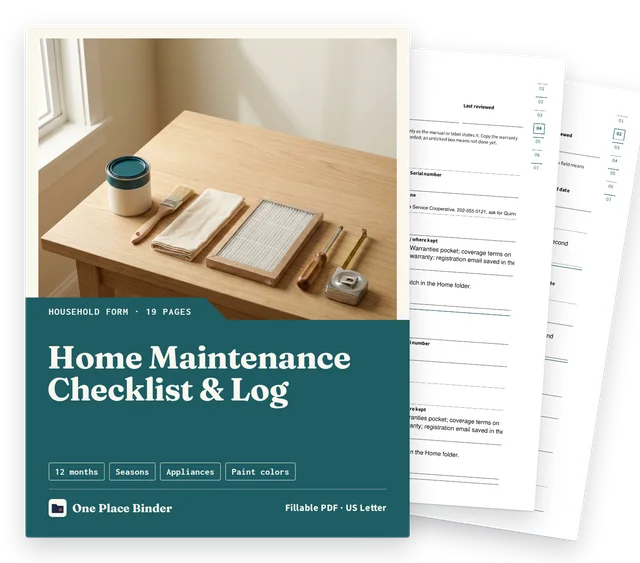
The Home Maintenance Checklist & Log keeps a home's recurring maintenance tasks and its records (appliances, paint colors, service history, contractors) in one file where the next person can find them. The Home Maintenance Checklist & Log is an instant download after checkout: one fillable PDF, US Letter. Home Maintenance Checklist & Log: $3.00. The Home Maintenance Checklist & Log prints no maintenance tasks, intervals or procedures. On the Home Maintenance Checklist & Log, every task row has a blank How often (from your manual) field for you to fill from your own manual or provider. Not legal advice. Not a will.
The honest limit of this page: the intervals are general U.S. agency guidance. Your manual, the extinguisher label, and your local fire marshal can name a different step. This page does not inspect the house.
Questions
What routine maintenance is required for a house?
No federal page opened for this guide publishes one list that every house must follow. Published intervals include a monthly smoke-alarm test from the U.S. Fire Administration, a monthly filter check from ENERGY STAR, dryer-lint cleaning each load from the Consumer Product Safety Commission, and a yearly heating and cooling tune-up from ENERGY STAR. Local rules can add an alarm type, so ask your fire marshal, and follow the appliance manual where it names a different step.
What home maintenance should be done monthly?
Test each smoke alarm monthly, per the U.S. Fire Administration. Check the heating and cooling filter every month, and change it if it looks dirty, per ENERGY STAR. Some fire extinguishers need a monthly shake; the extinguisher page says the label decides. A woodstove pipe or chimney, if you have one, gets a monthly look for damage or a blockage, per Ready.gov.
What should I include in my annual home maintenance checklist?
Include a yearly heating and cooling tune-up from ENERGY STAR, the smoke-alarm battery step that matches your alarm, and an annual chimney cleaning if you burn wood, from Ready.gov. Also copy model, serial, filter size, paint details and the last service invoice into a record, even though those are not themselves yearly tasks.
What maintenance should you do on your house every year?
Plan a heating and cooling tune-up once a year, replace a smoke alarm that is 10 years from its manufacture date, and clean a woodstove chimney annually if you use one. The U.S. Fire Administration and Ready.gov both name the 10-year alarm replacement, and they disagree on battery timing, so use the alarm instructions.