What goes in a moving binder
Published 2026-10-16 · Updated 2026-10-16

A moving binder is one place for the papers and the lists a move produces: the quote, the dates you chose, the box IDs, and who still has the old address. It is not a second household. The Homes I Have Made describes a printable pack with over 100 color-coordinated printable pages, and later says the pack has 200+ total printable pages. You can run a move with far fewer sheets if each sheet is a record you will actually fill in. The Homes I Have Made Smooth Move page describes a Change of Address Form to log finished updates and updates still open, and it says to find and print only the pages you need.
Sections worth keeping
Six sections cover the jobs. Add a tab only if you will put paper behind it.
- Move facts. Old address, new address, dates, and who has the keys. One page.
- Quotes and the mover. Company, phone, what the written quote includes and excludes, the agreed date, and a copy of anything you sign. On an interstate move, FMCSA's booklet says to attach the complete inventory to your copy of the bill of lading. Those pages belong in this section, not in a random carton.
- Utilities. One row per service: old-address stop date, new-address start date, and a confirmed tick for each. The provider's confirmation email can sit behind the row.
- Who still has the old address. Name, date notified, still-has-old-address, update confirmed. USPS says a change-of-address order only changes your address with the Post Office, and that you tell government agencies, companies, and other senders yourself. The binder is where you mark which of those calls is finished. USPS also says you get a Move Validation letter at the old address and a Customer Notification Letter at the new one. File both here.
- Box inventory. Box ID, destination room, contents, packed, fragile, loaded, arrived. Five rows on a page is enough if you print another page when you need it.
- Handoff. Open actions, who is responsible, by when, who else knows, and where this binder will live after move week.
Bobcat Movers describes six sections too: important documents, timeline, inventory, receipts, contacts, and floor plans. That is a sound skeleton. The page explains the tabs and does not show a quote record or a still-has-old-address row. The second result page is an Amazon search for moving planners. Titles on that page advertise page counts. The search page is a shop window, not a layout you can copy field by field.
How to set it up
- Use a binder you already own, or a single PDF you can reopen. Dividers help. Color is optional.
- Write the household name on the first page so a loose sheet still says whose move it is.
- Put originals of leases and signed estimates in a sleeve. Everyday working copies can be the filled rows.
- Update the file when a date moves. A binder that still shows last month's utility date will mislead you on move morning.
- Tell one other person where the binder is. The handoff page is that sentence, written down.
An illustrative contents line, not a product count: "tab 4, credit union, notified, still waiting on a mailed card." The example only shows how a row reads.
After each phone call, file the proof before you close the binder. A utility confirmation email goes behind the utilities tab. A USPS Move Validation letter and the Customer Notification Letter go behind the address tab, because those are the postal copies, not a substitute for the company calls. On an interstate move, the signed inventory and the bill of lading go behind the mover tab the same day you receive them. A binder that waits until Sunday to catch up is already behind the truck.
If you are using a physical binder, punch or sleeve only the pages you will reopen: the quote, the utility rows, the address rows, and the box list. Leave the lease and the closing papers in a sleeve at the front so they are not mixed with scratch notes. A digital copy of those four working pages is enough backup if the paper binder rides in the car and the scan sits in cloud storage you already use.
What does not belong in the binder
House-hunting notes, a full budget spreadsheet, a cleaning checklist, and a sell-or-donate list are separate jobs. Keep them if you use them. They are not required for the six sections above. Decorative quote pages are optional; the first result includes them in its large pack. Skip them if they do not hold a fact you will look up.
The day-of order is in the moving day checklist. The notify list, with the USPS rules, is in the address change checklist.
A short file instead of a 100-page pack
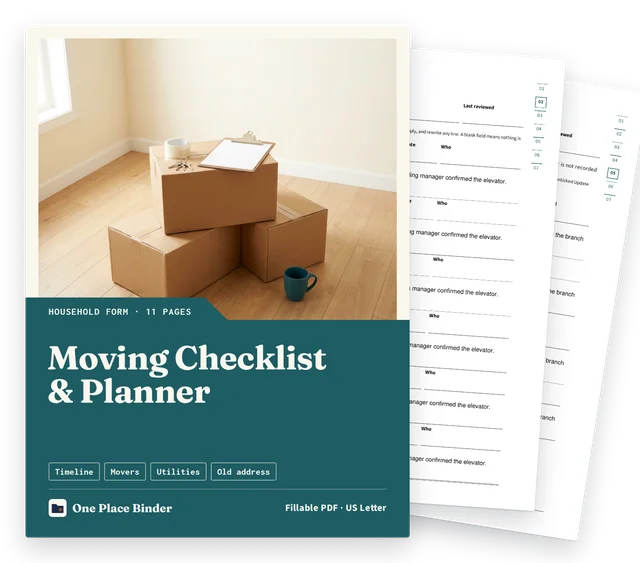
The Moving Checklist & Planner is one fillable PDF, US Letter, with handoff notes. The Moving Checklist & Planner is a start page with how to use the file, your move details and a contents list, plus a move notes and handoff page for open actions, who is responsible and by when, who knows and where the records are kept. Notes, follow-ups, contents and locations are two-line fields; long entries shrink to fit their box, and extra detail can stay on paper with its location noted. The Moving Checklist & Planner costs $3.00. Not legal advice. Not a will.
A folder of envelopes works if you label the envelopes with the six sections. The limit of either approach is the same: the binder only helps if you write the dates down when you agree to them.
Questions
How to get organized for moving house?
One binder, or one file, with a contents list. Put the quote, the utility stop and start dates, the box IDs, and the names that still have the old address in labeled sections. Update it when a date changes.