How to organize important documents at home
Published 2026-10-16 · Updated 2026-10-16
Organize important documents in four moves. Sort them into the groups on FEMA's safeguard sheet: household identification, financial and legal papers, and the contact names you would need with those papers. Write an index that names each paper, where the original is, where a copy is, who else knows, and the date you checked. Tell one trusted person where that index is. Shred papers you discard when they show personal information, as the FTC describes.
The folders are only there so the index stays true. A new box does not organize anything until the index says what is in it.
Groups worth a folder
FEMA's safeguard sheet starts with an inventory. Use these groups, and leave out papers that do not belong in them.
Household identification covers vital records (birth, marriage, and divorce certificates, plus adoption or custody papers if you have them), a passport, a driver's license, a Social Security card, a green card or military identification if you have one, and pet ownership papers.
Financial and legal papers cover the housing file (lease, mortgage, deed), the vehicle file (title, registration, loan papers), insurance policies, tax statements, and account statements you are still keeping. A will, a trust, or a power of attorney, if you have signed one, goes in this group too. Those three are made with an attorney or through the official process for that document. This page does not tell you which ones to create. File the signed copy you already have, and write down where it is.
Contact names are the people tied to those papers: the bank, the insurer, the school, the employer, a house of worship, and home-repair services. FEMA lists them on the same sheet so a phone number sits with the policy, not in a separate junk drawer.
Health insurance cards, and a caregiver contract if you have one, can sit in their own folder. Write the insurer name on the index, and write where the card is. Do not copy treatment notes into the index. The index is a map of papers, not a care record.
Ready.gov's financial preparedness page says to store important documents in a safety deposit box, on an external drive, or on the cloud so you can reach them. That is a storage choice. It still needs a line on the index, or the cloud folder is just another place you have to remember.
Write where each original is
A folder name is not a location. "Taxes" does not say whether the original return is in a closet, a bank box, or a file your accountant holds. Keep one paper index with the folders.
| Column | What to write |
|---|---|
| Paper | The document name and whose name is on it |
| Original | The room, container, and shelf, or the bank and box, or the office that holds it |
| Copy | A second paper copy, a drive, or a cloud folder, if you made one |
| Who else knows | One person who can find the index without a search |
| Checked | The date you last confirmed the original was still there |
Illustrative index rows
These rows are illustrative. They are not a real household.
| Paper | Original | Copy | Who else knows | Checked |
|---|---|---|---|---|
| Birth certificate, Jordan Lee | Fireproof box, hall closet, top shelf | Scanned file in the household drive, folder Identity | Sam Lee | March 2026 |
| Deed for the house | Bank safe deposit box | Paper copy in the housing folder | Sam Lee | March 2026 |
| Auto policy, current term | File drawer, left side | Insurer's online account | Sam Lee | March 2026 |
When you move a folder, change the index the same day. An index that names an old shelf is worse than no index, because someone will look in the wrong place and stop.
Who else knows
FEMA's safeguard sheet includes a trusted friend or relative as a place to keep paper copies, and it says to ask a bank who can and cannot open a safe deposit box. Write that person's name on the index. Tell them, in plain words, where the index is kept. You do not need to hand them every original.
Do not put passwords, PINs, or full account numbers on the index. The FTC says to keep financial records, Social Security cards, and Medicare cards in a safe place, and to shred them when you decide to get rid of them. The index can say "Social Security card, fireproof box, hall closet" without writing the number.
Papers you will not keep
Sort once, then stop filing paper you do not need. A receipt with no tax use, a closed offer, and a manual you can read online do not earn a folder. If the paper shows an account number, a Social Security number, or a full card number, shred it. The FTC says that if you do not have a shredder, look for a local shred day, or block out the numbers with a marker.
The NewlyNamed important-document organizer collection has no index of where each original is kept. NewlyNamed is stronger as a shop page of organizers. The FileCenter filing guide has no handoff for who else knows the location. FileCenter is stronger on scanning and choosing file names.
A page for the index
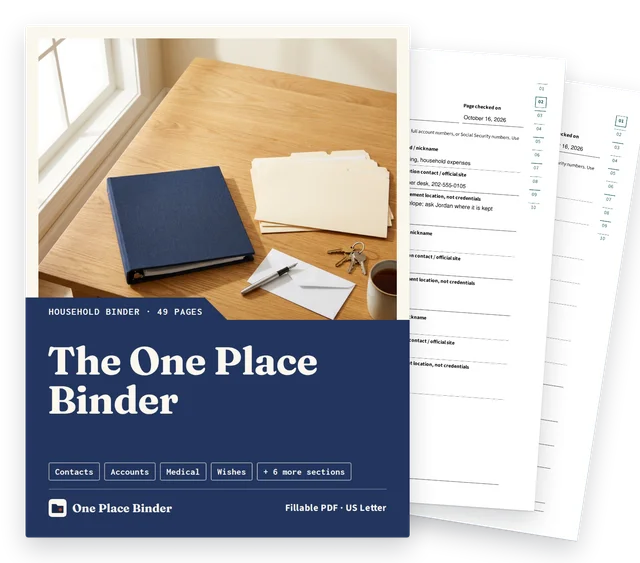
The One Place Binder has document-location pages and an index, plus a handoff page for telling someone where the binder is kept. It keeps one household's contacts, accounts, insurance, property and car, pets, digital life, document locations and wishes in one place. The One Place Binder is a fillable PDF, 49 pages, on US Letter paper. The One Place Binder is $11.99. Pages ask for locations and last four digits only, with no passwords or full account numbers. Not legal advice. Not a will.
This system helps you find papers. It does not decide how long a tax record must be kept, and it does not create a will. The papers worth a line on the index are listed in the important documents list. A wider household set of the same idea is the home binder guide.
Questions
How do I organize my important documents?
Sort them into a few groups, write down where each original is, and tell one person where that index is kept. Use the groups on FEMA's safeguard sheet, then keep the index with the papers.
What is the best way to organize important documents?
A short index beats a new pile of folders. Name the paper, the spot where the original sits, the spot where a copy sits, who else knows, and the date you checked.
What is a good document organizer for home use?
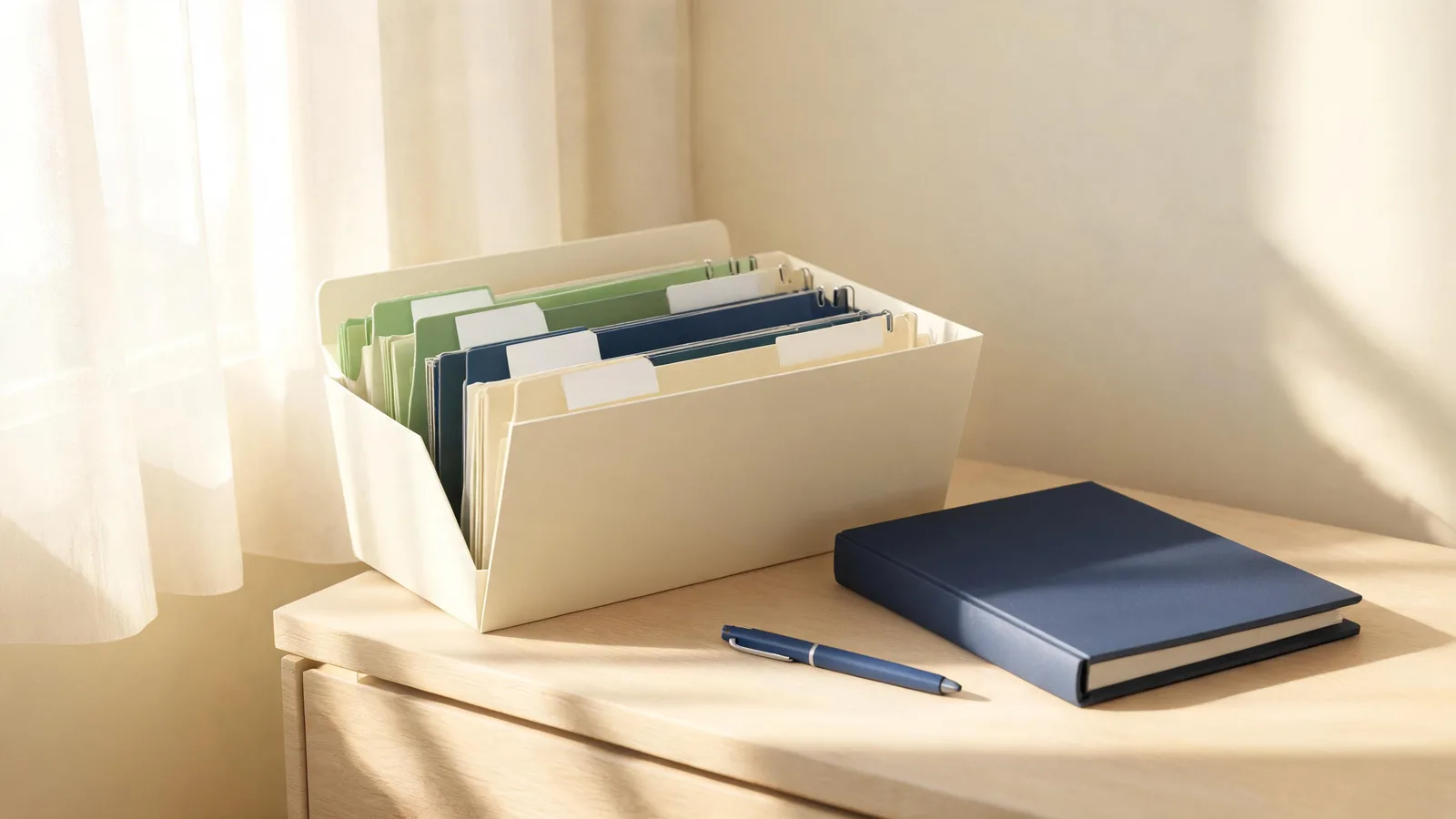
A labeled file box for current papers, plus a fireproof and waterproof box for originals that are hard to replace, is enough for most homes. The organizer is the index, not the brand of the box.
How do you organize your important documents?
Group identification papers, financial and legal papers, and contact names. Then make one index of locations and show that index to one trusted person.
What is the best way to organize my home documents?
Start with the papers you would need to prove who you are, what you own, and what you owe. File the rest by year only after those originals have a line on the index.
What is the best way to file important documents?
File by the kind of paper, not by the month it arrived. Put a location line on an index so the folder name and the real spot stay the same.
How to organize family documents?
Give each person a line on the same index. Note whose name is on the paper, where the original is, and who else in the household knows that spot.
What is the best document organizer for home use?
Use a box you can label and a single index page. A shop catalog of organizers does not tell you where your own originals are.
How to organize and keep important documents?
Sort, index, and name one person who knows the index location. Shred discards that show an account number or a Social Security number.
What is the best way to organize important documents at home?
Keep active bills where you pay them, and keep hard-to-replace originals in the fireproof and waterproof spot you wrote on the index. Do not file both in the same unlabeled drawer.
How should I organize my important documents?
Four moves: group the papers, write the index, tell one person, and shred what you will not keep. The groups come from FEMA's safeguard sheet.